Why Warehouse Floor Problems Often Get Misdiagnosed
by Loral Concrete Slab Solutions
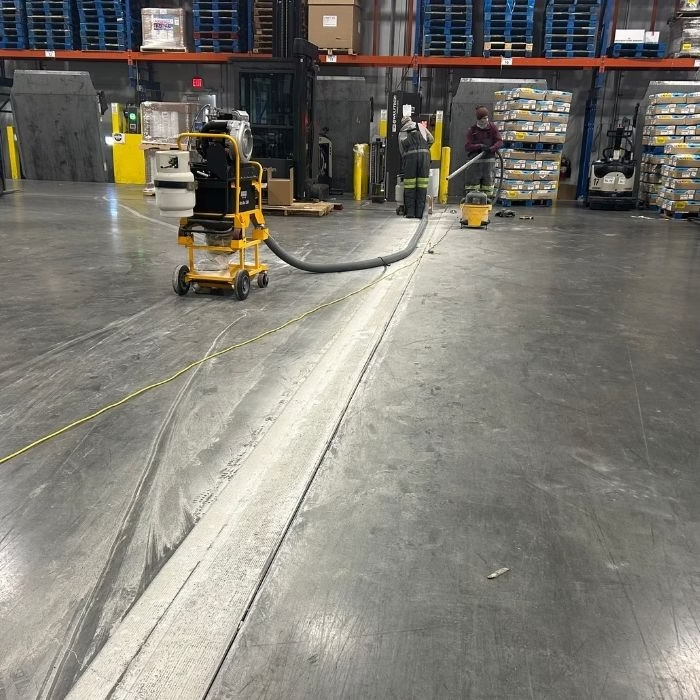
When a warehouse floor starts showing signs of damage, most people focus on what they can see.
A crack appears near a joint. A section of floor begins to settle. Forklift operators start complaining about a rough area that wasn’t there before. Sometimes a repair is made right away. Other times, the problem gets monitored until it becomes impossible to ignore.
The challenge is that visible damage doesn’t always tell the whole story.
In many facilities, the real issue isn’t the crack, the spalling, or the joint deterioration. The real issue is what caused those things to happen in the first place.
That’s why warehouse floor problems are often misdiagnosed, and why some repairs fail long before they should.
The Visible Damage Is Usually a Symptom
Concrete floors rarely fail without a reason.
When damage appears, it’s often the result of conditions that have been developing beneath the surface for months or even years. Settlement, support loss, moisture conditions, loading patterns, joint movement, and construction-related issues can all contribute to floor deterioration.
The problem is that many of these conditions are not immediately visible.
What facility managers see is the symptom. What causes the symptom is often hidden below the slab or occurring over a much larger area than expected.
A crack may not simply be a crack. A failing joint may not simply be a joint problem.
That’s where misdiagnosis begins.
Why Similar Problems Can Have Different Causes
One of the reasons warehouse floor evaluations can be challenging is that the same type of damage can result from very different conditions.
For example, two facilities may both have a deteriorating joint. In one building, the issue could be caused by heavy forklift traffic and years of normal wear. In another, the joint may be failing because one side of the slab has settled and is no longer properly aligned.
The visible damage looks similar.
The repair strategy should not.
When the underlying cause is overlooked, repairs often address the symptom instead of the actual problem.
The Cost of Treating the Wrong Problem
Misdiagnosis doesn’t always show up immediately.
In fact, many repairs look successful at first. The damaged area is patched, the floor looks better, and operations continue as normal.
Then six months later, the same issue comes back.
Or it appears a few feet away.
Or the damage begins spreading into surrounding areas.
At that point, the facility has paid for a repair without solving the condition that caused the damage in the first place.
Over time, those repeated repairs can become far more expensive than identifying the root cause from the beginning.
Common Issues That Are Frequently Overlooked
Some warehouse floor problems are easy to identify. Others require a closer look.
A few conditions that are commonly missed include:
- Slab settlement
- Loss of support beneath the floornt
- Voids beneath concrete slabs
- Joint movement
Moisture-related conditions
- Floor flatness issues
- Load-related distress from equipment or operations
These issues often create secondary damage that draws attention away from the actual source of the problem. As a result, repairs may focus on what’s visible while the underlying condition continues to develop.
Why Recurring Repairs Are a Red Flag
One of the clearest signs of a possible misdiagnosis is recurring damage.
If the same joint continues breaking down, the same crack keeps reopening, or the same area requires repeated repairs, there is usually a reason.
Concrete doesn’t typically fail in exactly the same way, in exactly the same location, over and over again without an underlying cause.
Repeated failures often indicate that something affecting the slab’s performance has not been fully addressed.
The repair itself may not be the problem.
The diagnosis may be.
Looking Beyond the Surface
Experienced concrete investigations often involve looking beyond the damaged area itself.
Instead of asking, “How do we repair this?” the better question is often, “Why is this happening?”
That shift in thinking can completely change the repair strategy.
A deteriorated joint may actually be a settlement issue. A crack may point to support loss beneath the slab. What appears to be normal wear may be evidence of a larger floor performance problem.
Understanding those relationships is what allows long-term solutions to be developed.
Why Root Cause Matters
The goal of any repair should be more than making the floor look better.
The goal is restoring performance and preventing the problem from returning.
That becomes difficult when decisions are based solely on visible damage.
By identifying the conditions contributing to floor deterioration, facility managers can make more informed decisions about repairs, budgeting, maintenance planning, and operational risk.
In many cases, the investigation itself becomes the most valuable part of the process because it provides clarity before significant repair dollars are spent.
Solving the Right Problem
Warehouse floors are critical to daily operations. They support equipment, inventory, employees, and production activities. When problems develop, it’s natural to focus on the visible damage first.
But visible damage is not always the whole story.
At Loral Concrete Slab Solutions, we believe the most effective repairs start with understanding why the problem exists. Through concrete investigations and floor evaluations, our goal is to identify the root cause of deterioration so repairs can address the actual issue, not just the symptoms.
Because the best repair isn’t always the fastest one.
It’s the one that solves the right problem.